Storm & Urgent Situations
Broken Tree Limb Hanging Over Your House: What Should You Do?
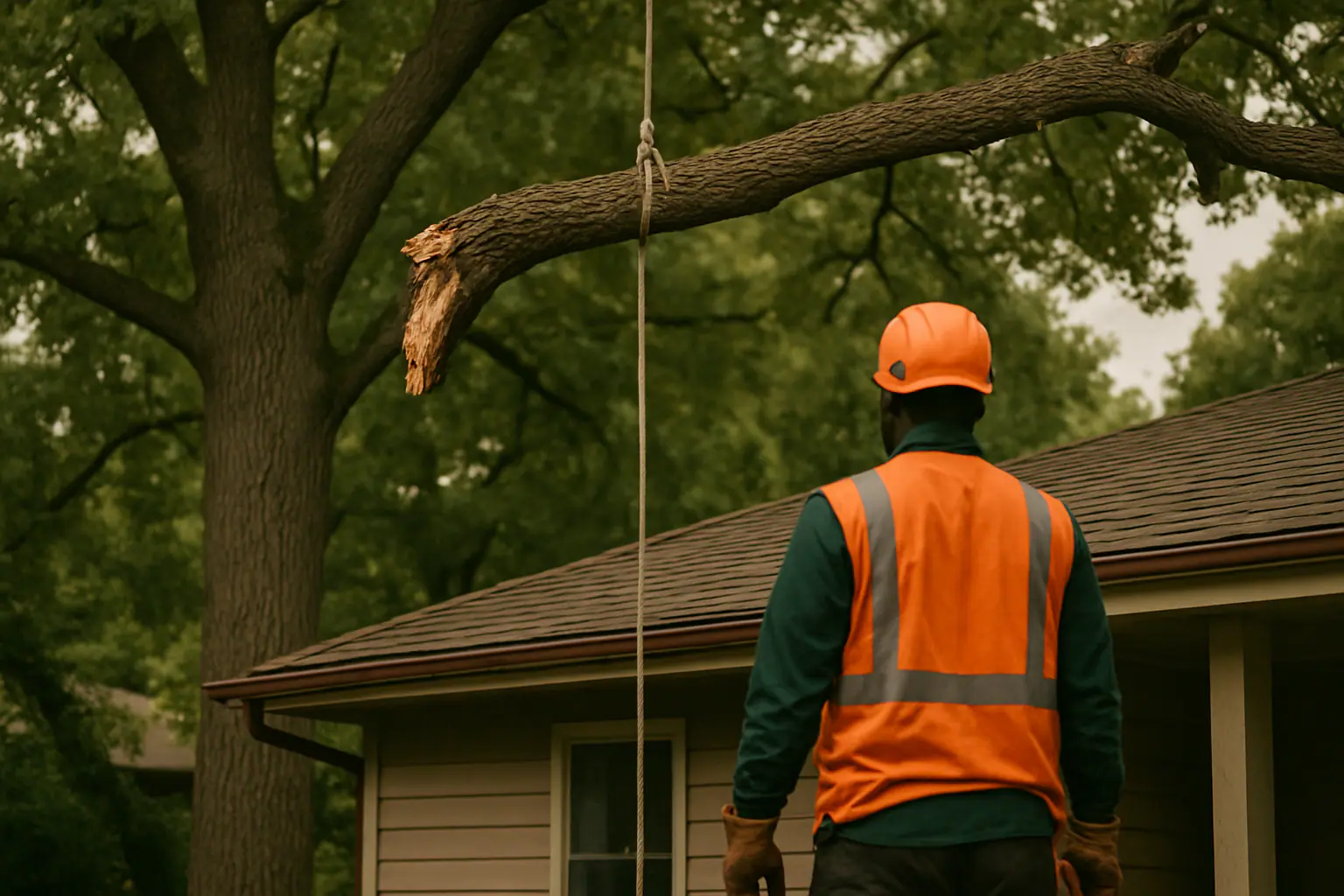
A broken limb hanging over your house should come down promptly and professionally — every hour it hangs adds weight-loading from rain absorption and wind-catching leverage to a structure already failing. The good news: rigged removal of hung limbs is routine, predictable work when handled correctly.
Why Hanging Limbs Get Worse Fast
Three mechanisms compound. First, gravity works continuously on wood fibers already failing — cracks lengthen microscopically under constant load. Second, rain-soaked hung limbs gain surprising weight; a limb absorbing overnight rain can weigh hundreds of pounds more by morning. Third, wind catches the cantilevered end like a sail, flexing the crack through cycles that fatigue remaining fibers. Together they explain why hung limbs so often fall quietly at 3 AM days after the storm that broke them.
What NOT to Do
- Don't pull it down with rope from the ground — redirected force drops it wherever physics chooses, often onto exactly what you feared
- Don't climb the roof to push it — limb failure and roof slipperiness combine badly
- Don't cut the attached end hoping it swings away — compression-side cutting drops the far end straight down
- Don't park vehicles or move equipment under it while arranging removal
- Don't ignore small ones — ten-inch hung limbs kill people too; size correlates poorly with danger perception
How Professionals Actually Remove Hung Limbs
- 1Assess the hang: attachment condition, weight estimate, drop path, and what the limb would strike uncontrolled
- 2Rig above or beyond the break: ropes set to control the piece from the moment it separates
- 3Load the line: tension applied so the limb transfers onto the rope system rather than free-falling
- 4Cut from the correct side: sequencing ensures the far end lifts into controlled descent instead of slamming
- 5Lower deliberately: speed matched to obstacles below — slow past roofs and lines, faster over open lawn
- 6Finish the pruning: the remaining stub gets proper collar cuts so the wound seals cleanly afterward
This is ordinary work for equipped crews and extraordinary risk for improvisation — the asymmetry that makes the service call obviously worth it. Homeowners in Higginsville and surrounding towns can reach us at (855) 714-0391; describe the hang and we'll give current scheduling honestly.
After Removal: Addressing Why It Broke
Hung limbs have causes worth identifying: included-bark attachments doomed from youth, previous topping creating weakly-attached regrowth, decay hollowing the joint, or simply end-weight exceeding wood strength in saturated conditions. Knowing which applies predicts whether siblings on the same tree face identical futures. A structural pruning assessment after emergency removal often prevents the sequel — see also our guide to pruning warning signs for what arborists look for.