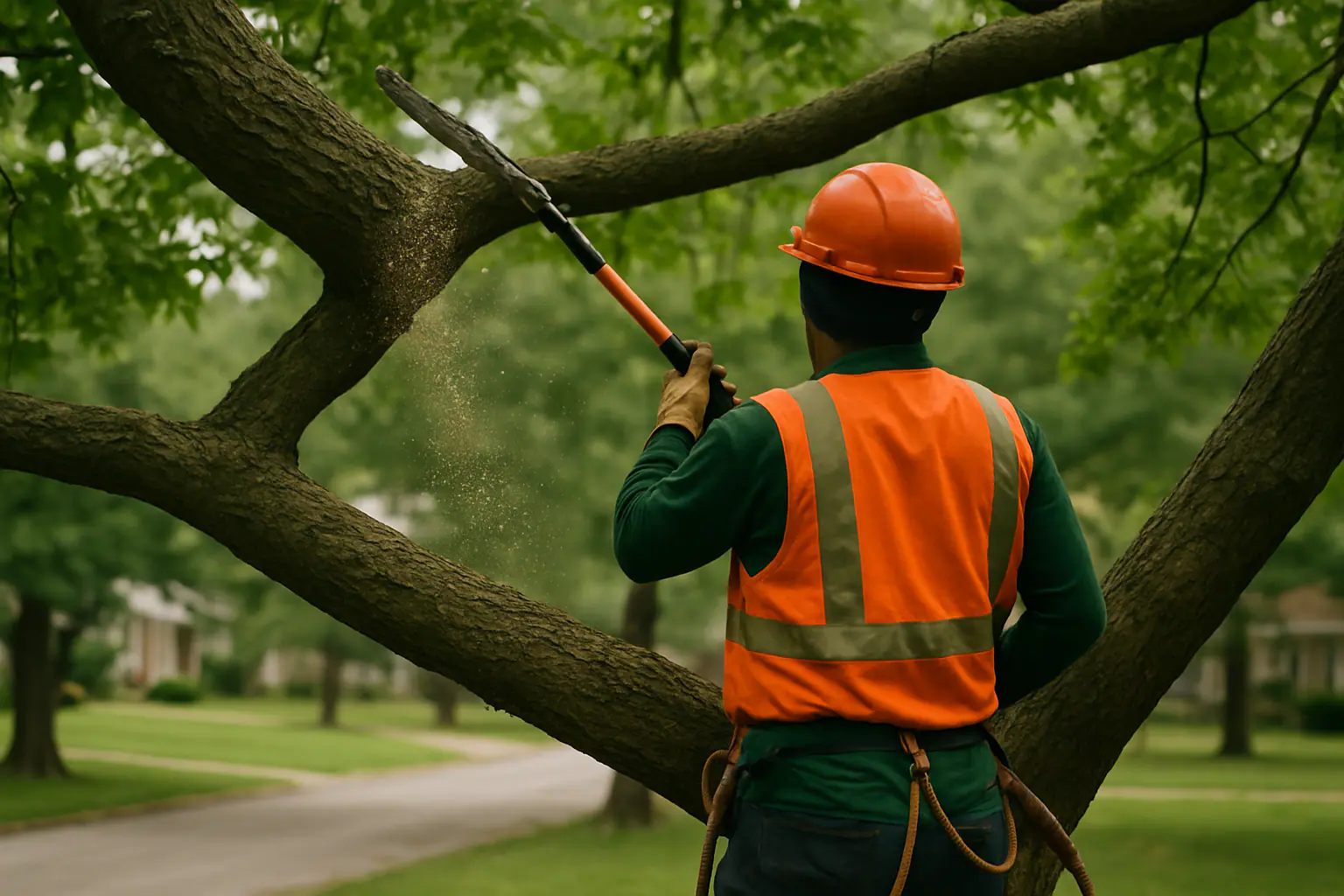
If a branch is rubbing your shingles or your maple has gone bald-and-bushy at once, call (855) 714-0391 — we'll tell you honestly whether the tree needs a trim, a prune or nothing at all this year.
What Proper Trimming Includes
- Deadwood removal — dead branches anywhere in the canopy, which are the first things to drop in a storm
- Crown thinning — selective limb removal so wind and light move through the tree instead of loading it like a sail
- Crown raising — lifting low limbs off driveways, walks, mowers and rooflines
- Clearance cuts — branches off the house, garage, well house, fences and service drops
- Rubbing and crossing limb correction before bark wounds become rot entry points
- Storm-ready shaping for trees that have grown lopsided toward an opening or field edge
Which Trees Around Corder Need Trimming Most?
The usual suspects in this part of Missouri are fast growers with soft or brittle wood: silver maples, Siberian elms, cottonwoods, Bradford-type ornamental pears and willows. They add shade quickly, then start shedding limbs about the time they reach the roofline. Slower, stronger trees — white oak, bur oak, walnut, honey locust — mostly need deadwooding and occasional thinning rather than frequent shaping. Pin oaks are their own category: lower limbs die naturally as the tree matures and usually need periodic raising off yards and drives.
When Is the Best Time to Trim?
Deadwood and hazardous limbs can be removed any time of year. For live-crown work on oaks, timing genuinely matters: avoid pruning oaks from April through July, when fresh cuts can attract the insects and fungus that spread oak wilt. Late winter is ideal for most structural trimming — you can see the branch framework, the ground is firm, and the tree heads into spring ready to seal its cuts. Elms follow a similar logic for Dutch elm disease reasons. If your tree is urgent, though, safety beats calendar: a cracked limb hanging over a roof should come off regardless of month.
What Does Trimming Cost?
Trimming price follows access and volume: how high the work is, how many limbs, how close obstacles are, and how much debris ends up on the ground. A small ornamental pear is a morning errand; a 60-foot silver maple over a house is a different conversation. Rather than inventing numbers that don't survive contact with your actual yard, we quote after seeing the tree — call (855) 714-0391 or send photos through the quote form.
Why Not Just Top the Tree?
Topping — cutting main limbs back to stubs — is still common around farmsteads, and it is the fastest way to ruin a shade tree. Topped trees respond with a burst of weakly attached shoots that are exactly the kind of growth that fails in ice storms, and the decay introduced at the cut points shortens the tree's life. Proper trimming removes whole branches back to their origin, which keeps the tree's natural shape and its strength. It costs a little more today and saves the tree for decades.
Tree Service in Nearby Communities
- Tree Trimming in Corder, MO
- Tree Trimming in Higginsville, MO
- Tree Trimming in Concordia, MO
- Tree Trimming in Lafayette County, MO